
As I approach my eightieth year of life and tenth year as a retired pastor, I find myself identifying with old salmon as they near the end. Having long swum upriver, wriggled through many a man-made chute, leaped up vertiginous falls, and finally reached the still waters surrounding the fountainhead, I am eager to deposit all the seeds of life so richly stored within me, fondly hoping to quicken a generation of preachers to come.

In pursuit of that goal, I have lately been depositing sermon outlines on my website: the literary remains of many years of pulpit ministry (here). While doing so, I happened upon some notes I had jotted down, not for the people in the pews, but for the man in the pulpit. In them I was trying to remind myself of the elements of a good sermon: a sermon that is given by God, shaped by God, and—if delivered in the power of his Spirit—edifying to the people of God.

With a few fresh modifications born of further homiletic experience—both bitter and sweet—I have reproduced these notes here, hoping that by adding precept to example I might strengthen young preachers in their way.

Have I always followed my own counsel? As you will see if you sample my sermons, I have not. But as it is written: the gifts and callings of God are without regret or change (Rom. 11:29). This comforting truth applies to preaching. God does not call his heralds to constant second guessing; as a rule, he calls them, trains them, and anchors them in a longstanding approach to sermon preparation that seems good to him and good to them.

What follows is mine. May it be a blessing to you as you seek yours.

I. What is an Expository Sermon?

What is an expository sermon? As the word itself declares, it is a sermon that intends to expose: to display, manifest, and illuminate the deep meaning and practical applications of a biblical text (Neh. 8:8).1

Importantly, the character of an expository sermon will largely depend on the spiritual gifting of the man who gives it (Rom. 12:3-8; 1 Cor. 12:4-11; Eph. 4:7-11).

Is the preacher called to be an evangelist? The thrust of his sermon will be to expose the biblical gospel—and in particular, the divine Person and redemptive Work of Christ—with a view to the salvation of souls and the ingathering of the Church.

Is the preacher a teacher? The thrust of his sermon will be to expose the meaning and implications of a biblical text with a view to the enlargement of the saints’ understanding of God’s revelation, their enjoyment of the same, and the formation of a truly biblical worldview; in short, with a view to the upbuilding of the Church.

Is the preacher a prophet? Much like the teacher, he too will expose a biblical text for the instruction and spiritual formation of the church, but with this difference: In his words of edification, exhortation, and encouragement he will be aiming to address this particular people, at this particular time, in order to get (or keep) them walking closely with their Lord in this particular set of circumstances (1 Cor. 14:3; Jude 3-4; Rev. 2-3). Prophecy is a biblical “now” word from the Lord (Rev. 2-3).

Wise preachers understand these things. They know the spiritual gift the Lord has given them, and they devote themselves to it, purposing to stand strong in their charismatic sweet spot. However, they also understand that a good sermon will often involve all three homiletical thrusts. For example, the heart of the evangelist will pant to proclaim the gospel and see souls come to Christ; but, for the sake of the believers in attendance, he also will find the Lord enabling him to teach and prophesy. And the case is the same for teachers and prophets: While majoring in their major gift, they will watch for the Lord to minor them in the others as well.

This, by the way, is why a church is especially blessed if it has created a team of biblically qualified and charismatically diverse elders—a team that includes, quite intentionally, pastors, teachers, evangelists, and prophets (Acts 13:1-3).2 If, then, you happen to be the lone under-shepherd of one of God’s little flocks, you must ask him to help you enter the pulpit wearing a charismatic coat of many colors.

In what follows I will be sharing principles of sermon preparation that should assist all preachers, whatever their gift(s) may be. But my main goal will be to highlight a single principle underlying them all. It is this:

God loves his people and desires to see Christ (more perfectly) formed in them, for their joy and his glory. To this end, sermon by sermon, he will faithfully give his gospel heralds a powerful, life-transforming word—a single Big Idea, embedded in a single text—and then will enable him to deliver that idea in the power of his Holy Spirit, who in turn will bring it to life in the hearts of his children. Therefore, above all else, the preacher must prepare for this great transaction by standing in the counsel of the Lord: by prayerfully drawing near to the Lord, waiting upon the Lord, listening for the Lord, and receiving from the Lord the one text, and the one Big Idea embedded in the text, that the One Preacher would have him proclaim to his children, so that they might be further conformed to Christ (Jer. 23:18; Ezek. 3:1-4; 33:33; 36:11; John 14:10; Acts 4:8; 1 Cor. 2:13; 1 Pet. 4:11; Rev. 10:10).

Yes, there is more to sermon preparation than this. But to my mind there is nothing more important than this. A preacher’s persona may seem to be eccentric, his attire distracting, his sermon construction flawed, his delivery clumsy, and his message too long or too short, etc. But if he has received and faithfully delivered the one Big Idea that God wanted him to impart to his people, the sheep will know it. And having heard the Good Shepherd’s voice, they will gladly overlook all the rest (John 10:27).

II. How to Prepare an Expository Sermon

Here, in words specially directed to you who preach, are five suggestions for sermon preparation that I hope will prove helpful.

      1. Prayerfully seek and receive from the Lord the text you are to preach on. Happy are you if he has led you to preach through a book of the Bible; in that case, your text is largely before your eyes. But even so, you still will need his special guidance in deciding how much text to bite off, and where your emphasis will lie. // As a rule, it is more profitable to deeply probe a shorter text than to superficially exposit a longer one. On the other hand, it is indeed possible that the Lord will occasionally have you preach on a longer text—perhaps even a whole chapter—if, as you work your way through the text, you are constantly relating the main points (MPs) to the Big Idea you are trying to get across. If, in such a sermon, all the MPs are little planets revolving around a great big ideational sun, the flock will behold the system and all will be well.

     2. Prayerfully seek and receive from the Lord the one Big Idea in the text, or entailed by the text, that you believe is on his heart for this people, in this sermon, for this occasion. This is what I call the “prophetic core” of your sermon: the idea around which you will seek to organize and integrate your message. It is the idea you believe the Lord wants his people to hear, understand, remember, and apply in their lives as they head out into the world to serve him in the week ahead. It is the idea you believe will further their formation in Christ, remind them of God’s redeeming love, and refresh them in the joy of their salvation (2 Cor. 1:24; Gal. 4:19; Phil. 1:25; Jude 1:24-25). // In order to determine the Big Idea of your sermon, you will need first to prayerfully study your text. Pray, asking the Lord to help you see how best to break it down into its component parts. Normally, the several parts will contain the MPs of your sermon. // There is a dynamic interplay between the Big Idea and the MPs of a text. With the Spirit’s help, the Big Idea will guide you as you choose and develop your MPs; the MPs will help you discern, distill, and state the Big Idea. Your audience should feel the unity of your sermon. The Big Idea is a single ray of bright light from the Lord; your sermon is the prism that diffracts that light into a spectrum of MPs. In this way, the Holy Spirit exposes the variegated beauty of the truth that is embedded in your text. // How many parts and MPs should the body of your sermon contain? For the sake of simplicity and memorability, three are probably the ideal; but in this matter, a hard and fast rule is impossible, since the text and the Spirit may require more. In my experience, a good sermon can handle a larger number of MPs, if they are clearly related to, and organized around, the Big Idea. This preserves the unity of your sermon. If they are not so integrated, you will wind up preaching what I call a “porcupine sermon”: a sermon loaded with so many points that you leave your audience stuck and in pain, desperately searching for the main point of what you said.

     3. Prayerfully determine how you would like to introduce your sermon. This will usually involve a cynosure, an opening “hook” or “whistle” designed to capture attention and awaken interest. It could be an anecdote (historical or contemporary), personal testimony, quotation, video clip, or question (which, in the body of the sermon, you will go on to answer). The crucial point here is that your whistle must lead you—logically and organically—to an initial statement of your Big Idea, and also, perhaps, of the MPs you will be using to illuminate your Big Idea (see the outline below). // Also, when you are preparing the conclusion of your sermon, prayerfully consider whether you might profitably circle back to your opening cynosure, fleshing it out and bringing it to full flower. This can contribute mightily to the unity and impact of your message.

      4. Prayerfully create the body of your sermon. This will require an outline. The several parts of your text—and the MPs you intend to draw from them—will richly guide you as you construct it. // If you are working your way through a book of the Bible, you may want to begin this part of your sermon by reviewing ground previously covered. But beware: It is terribly easy to waste precious time with a lengthy review of material that most folks heard last week. A good sermon should be able to stand on its own, without the prop of a long review. // Suppose you have broken down your text into three parts; if so, the outline of the body of the sermon will have three parts. Consider giving each one a title that incorporates the MP you will draw from this text. Next, in a sequence that seems good to you and the Holy Spirit, plan to: 1) read the text, 2) make brief explanatory remarks about key terms, ideas, and biblical and historical references, 3) spotlight and develop the MP you desire to make, using biblical cross-references, relevant quotations, and interesting illustrations, and 4) climax your exposition with one or two practical applications that you feel the Lord would have you make. And in all of this, do all you can to keep your Big Idea squarely before your people. // Never to forget: An expository sermon is not a running commentary on the text, and to preach it in this manner is to risk disaster. Yes, your text is loaded with fascinating details, and crying out to be linked with other texts and other ideas; and if you are a Bible teacher, your peculiar temptation will be to point out every one of them. But if you yield to the temptation, you will find that you have left your flock behind, lost in the weeds. All we like sheep are hard wired for sweet simplicity, and hunger for it. A wise preacher understands this, and purposes: Never to forget.

      5. Finally, prayerfully prepare your conclusion. Having outlined your sermon, it is time now to decide how you want to end it. As a rule, this will involve a final repetition of the Big Idea and the MPs you made to illumine it; it may well involve highlighting a single application that is much upon your heart, especially if you have the prophetic gift; and ideally it will involve a strong closing illustration, anecdote, quotation, poem, hymn, video, etc. Such a conclusion could well ensure that your people will never forget the Big Idea the Lord has laid upon your heart to deposit in theirs.

Before passing on to a suggested sermon outline, I want to conclude this section with two final thoughts.

First, in all that I have said so far, my Big Idea should be clear: Your sermon must contain a Big Idea from God, and your people must not miss it. After the service, no one should be overheard asking his neighbor, “In a few words, can you tell me what that sermon was all about?”

In the guidelines offered above, I have sought to preclude such a calamity, and here is one very practical way to do so: Keep your sermon short, say between 20 and 40 minutes. After failing in this department for decades, I have concluded that brevity and focus are actually your friends: they are two strong sentinels, faithfully standing guard over your sermon, ensuring that you yourself will stick to point, and that your people will get it!3

Secondly, despite all I have said so far, I most heartily confess that I find in Scripture no set method or formula for sermon construction. What I do find—in both precept and example—is this fundamental rule: The word of the preacher must be a word from the Lord, and it must be delivered in the power of his Spirit.

God is a jealous God. He will not let his preachers fall into idolatry, even into the idolatry a rules-based method of sermon construction. Yes, over the years I have found the above principles helpful for sermon preparation. I believe the Lord has been in them (or something close to them) all along the way. But more than once, in the face of abject spiritual poverty, I have had to take a fresh approach to constructing my sermon. And more than once, when I actually entered the pulpit, I have had to abandon my sermon outline and let the Spirit rescue me from utter humiliation simply by opening the door, letting him in, and letting him have his way.

He is—and insists upon being—the Lord of all (Acts 10:36).

III. A Sample Outline of an Expository Sermon

I. WELCOME/INTRODUCTION

  • Welcome: Open with a warm personal word that connects the preacher with the people.
  • Reading of the Text: In liturgical churches, the text will likely have been read earlier in the service. // If not, you may read the text, or (with the help of a bulletin or overhead projector) you may read it together with congregation.
  • Opening Prayer: This is a prayer for God’s blessing on our time together in his Word. The prayer can come here, or at end of your introduction, just before you plunge into the body of your sermon.
  • Opening Hook/Whistle: This could be a personal testimony, anecdote, quotation, video clip, or thought-provoking question, etc.
  • Statement of the Big Idea: The whistle should lead naturally into a brief statement of the Big Idea that is on your heart to share with God’s people.
  • Overview/Outline: Here you also may want to preview the MPs you will be making in order to illuminate the Big Idea; or you can simply plunge into your sermon, introducing the MPs as you go along. // If you decide to preview the MPs, consider using a Power Point slide to display a simple outline of your sermon.
  • Caveat: Always keep in mind this staple of handbooks for writers: “Tell them what you’re going to tell them; tell them; tell them what you told them.” Here is wisdom for speakers as well.

II. THE BODY OF SERMON

A. Review: If your sermon is part of a series, a brief review of ground previously covered may be in order. But again, beware of lengthy reviews that rob you of the precious time needed to develop your Big Idea.

B. Part #1

      • Each part of your text should have a title; ideally, the title will incorporate the MP you plan to make. You may wish to begin by reading the title; or you can draw out the MP as you read and comment on the text.
      • Read through this part of your text, briefly commenting on the terms, concepts, and historical details your people need to know in order to grasp the MP and its relation to the Big Idea.
      • Now isolate and discuss at greater length this MP, incorporating biblical cross-references, interesting quotes, anecdotes, and real-world illustrations designed to illuminate it. Be sure to show how this MP is related to the Big Idea of your sermon. At this juncture (and in the points ahead), you are standing in the furnace with One like a Son of Man. Pray that the fire will fall!
      • As led, conclude your discussion by drawing out one or two practical applications of this MP. I believe such application is the proper goal and climax of good preaching: that your people will see the Big Idea and the MPs that open it up, and then be moved to take one or more actions entailed by them. You may be led to press home a particular application; if not, you can trust that the faithful Lord will.
      • Note: When making applications, be sure to connect the text not only to the personal spiritual life of your people, but also to current events and the real-world issues of the day. As John Stott well said, the preacher stands between two worlds: the world above the church, and the world outside the walls of the church. A good sermon will shed light from the world above onto the world outside. This will interest and engage your hearers, and will help them apply and share biblical truth in the week(s) ahead.

C. Part #2: Repeat the above

D. Part #3: Repeat the above

Caveat: If you are thinking about making a fourth or fifth MP, think twice and pray. Make sure those extra points really are from the Lord, and not the result of your teaching gift running amok!

III. CONCLUSION

     A. Brief Review: You have exposed the Big Idea embedded in your text, and you have explored the MP’s related to it. Now, in a few sentences, “tell them what you told them.” Repetition is required for learning that lasts! // Also, if your sermon opened with a Big Question, now is the time to sum up and state the Big Answer.

    B. Final Application: As the Spirit may lead, briefly focus on one or two of the main practical applications of the text. For preachers who are prophets, this kind of thrust is pure delight.

     C. Conclusion: Now, put a big bow on the gift of your sermon by cycling back to your opening remarks and fleshing them out; or, by sharing a fresh anecdote, quotation, picture, poem, hymn, chorus, or short video. Choose something with heart that will beautifully reinforce the Big Idea that you found in your text and brought to your people.

     D. Closing Prayer: In a closing prayer for your flock, let the Lord bring to mind the truths and applications that you sense he specially wants to seal in their hearts, so that they may head home with fresh understanding, strengthened resolve, and deepened joy.

Note: For the close of the worship service, choose a hymn or chorus that reinforces the Big Idea of today’s sermon one final time.

IV. Theological Postscript:
Wherein Lies the Goodness of a Good Expository Sermon?

I trust that no one reading this essay has concluded that the goodness of an expository sermon lies in its structure. It does not. Its structure (which can vary) is like the skin on a piece of fruit (whose size and shape also can vary).  It contains and preserves the sweetness, and may justly be said to contribute to its beauty. But the true sweetness and the true beauty lie within.

So again, I ask: At the deepest level, wherein lies the goodness—the sweetness and beauty—of a good expository sermon?

My theological reply is a Big Idea consisting of three MPs: The goodness in a good expository sermon lies in the One who gives it, the One around whom it is centered, and the Christlikeness of the one who receives and delivers it.  

Let’s take a moment to unpack each of these three points.

First, the goodness in a good sermon lies in the One who gives it.

Ultimately, this is God the Father, but always through the Son, and by the Holy Spirit. He is goodness itself. When Moses asked God to show him his glory, he replied, “I will make all my goodness pass before you,” (Ex. 33:19). Being goodness itself, wherever goodness is found, he himself is found, in one way or another. God is good, and [all] he does is good (Psalm 119:69). Accordingly, all he gives is good: good in itself, good for the well-being of his creatures, good for the ingathering and upbuilding of his people, and good for their joy and his glory.

Very importantly, in whatever form it may take, the goodness of God always comes down. It is pure gift, pure grace. As James reminds all who are suffering temptation, “Every good gift and every perfect gift is from above, coming down from the Father of lights, with whom there is no variation or shadow due to turning” (Jas. 1:17). The apostle Paul also understood this, inviting the saints in Corinth to think long and hard: “What do you have that you did not receive?” (1 Cor. 4:7). Providentially, God comes down to his whole creation, that it might receive from him life, breath, and all things (Acts 17:25). Redemptively, he comes down to his people, that they might receive from him forgiveness of sins, imputed and imparted righteousness, and eternal life in and with the triune God. He does all this so that, in manifold ways, his people might come up to him.

Beholding these great principles, and recalling from Scripture the innumerable times and ways in which God came down to visit men and nations—the greatest (so far) being the first advent of his uniquely begotten Son—the preacher well understands: If there is to be a good sermon, the Father himself, through his Son, by his Spirit, must come down and give it to me. As we shall see in a moment, the preacher acts accordingly.

Secondly, the goodness in the preacher’s sermon lies in the One around whom it is centered.

Ultimately, this principle is rooted in the divine nature itself, and also in the eternal purposes of God for universal history. In both cases, the Son of God lies at the center; for which reason he also lies at the center of the Book that discloses them; for which reason he also must lie at the center of the preacher’s sermon.

Since these points are so important, let’s pause for a moment to illustrate them from Scripture.4

To a degree, and in a manner that passes my full comprehension, I reckon that the Holy Trinity is centered around the Son. This is because the decree of God concerning the course universal history did not occur in a moment of time, but is co-eternal with the being of God himself. Therefore, just as the Father eternally begets, knows, and loves the Son, so too does he eternally “beget” the plan of salvation that is centered around him. Similarly, just as Father and Son eternally breathe out the Spirit who proceeds from them both, so too do they breathe out the manifold work of the Spirit, which, above all else, is to manifest and reveal, in universal history, the Person and Work of the Son, so that all will honor the Son, just as they honor the Father (John 5:23; 16:5-15; 1 Cor. 2:6-13; Eph. 1:7-14; 1 Pet. 1:12).

Again, the purpose of God is centered around the Son, since God’s purpose in all things is that men (and angels) should honor the Son, just as they honor the Father; that in the end, every knee should bow and every tongue confess that Jesus Christ is Lord, to the glory of God the Father; so that, to all eternity, through the knowledge of the Central One, the saints and angels may be to the praise of the glory of the Ultimate One, and to the praise of the glory of his grace (John 5:23; Rom. 11:33-25; 1 Cor. 3:21-23; Eph. 1:3-14; Phil. 2:5-11; Rev. 5:11-14)

The many-faceted plan of God, observed in the unfolding of universal history, is also centered around the Son, and the Christ in whom he would become incarnate (Rom. 1:1-4).

Thus, the Son was at the center of the creation, for all things were created through him and for him; moreover, ever since the creation, all things are held together by him, and ruled by him, even as he himself, under the Father, directs all things to their appointed destiny, and to the consummation of all things at the end of the present evil age (John 1:1-2; Col. 1:15-17; Heb. 1:1-4; 1 Pet. 2:7-9; 4:7; Rev. 5:7; 6:1)

Mystically, he was at the center of the probation in Eden, for at the Tree of Life (which stood in the center of the Garden) God offered the family of man the knowledge of his Son, through whom alone the family might have come to know the good God, and all of his good gifts (Gen. 2:15-17; Rom. 5:12-14).

In a way, then, he also was at the center of the fall, for when Adam fell, he and his family man fell away from the Son, and therefore from God and all of the good gifts he held in store for them. And though it is true that in the first Adam the family of man fell into bondage to a great host of deadly enemies, both spiritual and physical, it is still more true that from that time on all of fallen mankind’s hopes for mercy, grace, and eternal life would lie in God’s promise of a last Adam—his incarnate Son—who would do all that the first Adam failed to do, and undo all that he had done (Rom. 5:12-20; 1 Cor. 15:20-18). So again, the Son was at the center of the fall, and also of mankind’s hopes for rescue from the fall, and for final restoration to God.

The Son was at the center of the promise of redemption, since, above all else, the Old Testament—in type, shadow, and predictive prophecy—was a promise of Christ: of the last and triumphant Adam; of the supreme Prophet, Priest, and King; and of the eternal Redeemer of his believing people (Gen. 3:15; John 3:10-21; 5:39-40; 6:29; Rom. 3:21; 5:12-20; 16:25-27; Col. 2:16-17).

He was at the center of the accomplishment of redemption, since he himself, under the Father and by the Spirit, accomplished redemption through his righteous life, atoning death, and vindicating resurrection (John 19:28-30; Rom. 3:21-26; 5:12-21; Col. 1:13-15; Heb. 7:27; 9:12; 10:10; Rev. 5:4-5, 8-10).

Today he is at the center of the application of redemption, since he himself, under the Father and by the Spirit, is applying the redemption that he accomplished on earth, and so gathering in, building up, guiding, gifting, empowering, preserving, sanctifying, and otherwise shepherding his Church on her spiritual journey to the world to come (Matt. 16:18; Acts 2:33; Eph. 4:7-16; 5:25-33).

And in the end, he will be at the center of the consummation of redemption, since he alone, under the Father and by the Spirit, will come again in glory, with all the holy angels, to raise the dead, judge the world in righteousness, and create new heavens and a new earth, the eternal home of the saints, the angels, and the triune God (Matt. 24:29-31; 25:31-46; 1 Cor. 15:20-28, 50-57; 1 Thess. 4:13-5:1-3; Rev. 19:11-21).

Understanding all this, the wise preacher also understands that the One whom the Father has lovingly placed at the center of his eternal purpose and plan, must surely be placed at the center of his sermon. Therefore, as he prayerfully settles upon his Big Idea and the MPs that will open it up, he remembers and takes to heart the words of Spurgeon: “I have never yet found a text that has not in it a road to Christ.”5

Finally, the goodness of a good sermon lies in the Christ-likeness of the one who receives and delivers it.

It is God’s purpose that all of his children should be conformed to the image of his Son; that they should display Christ-likeness (Rom. 8:29; 1 Cor. 11:1). But this is especially true of his gospel heralds, who, to be consistently effective in their ministry, must be richly conformed to the call, the character, and the conduct of Christ. Let us briefly consider all three.

As with Christ, so with his herald: no man takes this honor to himself. Rather, he is called by God (Heb. 5:4). And like his Lord, the preacher must not only receive the call, but also separate himself to it, and remain faithful in it.

Examples abound. The Lord called Peter, saying, “Feed my sheep” (John 21:15, 17). Peter received the call and was faithful to it, later on explaining to the burgeoning church in Jerusalem, “It is not right for us to neglect the Word and serve at tables . . . We [apostles] must devote ourselves to prayer and the ministry of the Word” The same was true for Paul, who so keenly felt the weight of the call laid upon him by Christ himself, that he cried, “Woe to me if I don’t preach the gospel!” Which he did, faithfully, right up to the end . . . all the while exhorting his fellow heralds to do the same. As he wrote to his son Timothy, “I charge you, therefore, before God and the Lord Jesus Christ, who will judge the living and the dead at his appearing and his kingdom: Preach the word! Be ready in season and out of season. Convince, rebuke, exhort, with all longsuffering and teaching (Acts 6:1-4; 20:16-18; Rom. 12:7; 1 Cor. 9:15-18; 2 Tim. 4:1-3, 7; Rom. 12:7; 2 Pet. 1:12-15; Rev. 11:1-14).

An effective preacher must also be conformed to the character of Christ.  Indeed, through the sanctifying work of the Spirit, the very Person and Life of Christ himself must richly take shape within him and pour forth from him (Gal. 4:19).

And in this matter, there are no shortcuts. It takes time: time in the Word, time under the ripe ministry of older brothers; time in faithfulness to small things (Zech. 4:10); time in trial, bitter error, and sweet restoration; time in the rough and tumble of church life; and time upon the long, rough road of sanctification. Over such times, the preacher will become mature in Christ, increasingly conformed to the understanding, affections, integrity, purpose, and methods of his master. The Lord said, “The mouth speaks from that which fills the heart” (Matt. 12:34). A mature preacher—a man whose heart is filled with Christ—will therefore be found speaking the words of Christ to the people of Christ. And they will know it (1 Cor. 2:6; 14:20; James 1:2; 3:1-2; Heb. 5:14; 6:1).5

Finally, Christ-likeness means conformity to the conduct of Christ, by which I mean, above all, the manner in which Christ walked: in absolute dependency upon his Father. The older we become, the more clearly we see it: The Lord Jesus did not take his cues from men, or angels, or even from his own divine nature. Rather, having emptied himself of his divine prerogatives, he walked as a healthy human being was always meant to walk: taking his cues from Father God, consecrated to his will, attentive to his voice, and tender to the promptings of his Spirit. “On my own,” said the Lord, “I can do nothing. As I hear, I judge; and my judgment is just, since I do not seek my own will, but the will of him who sent me” (John 5:30; 8:28).

God our Father has predestined all his children—and especially his preachers—to walk as Christ walked. There is, however, this crucial difference, introduced by the New Covenant: Whereas Christ walked in dependence upon the Spirit of the Father, we Christians are called to walk in dependence upon the Spirit of Christ, through whom alone we also may come to know the Person, presence, heart, mind, will, and Spirit of God the Father (Matt. 10:20; 11:25-30; John 15:26). As the Lord urged upon (all) his true disciples:

“Abide in me and I in you. Just as a branch cannot bear fruit from itself unless it abides in the vine, so too you cannot bear fruit unless you abide in me.  I am the vine, you are the branches. He who abides in me and I in him—he will bear much fruit; for apart from me you can do nothing . . .  By this my Father is glorified: that you bear much fruit, and so prove to be my disciples.” –John 15:4-5, 8

Every true preacher understands: This is the only possible foundation for an effective ministry of the Word. Such a realization induces a glorious mixture of spiritual poverty, fear, trembling, wisdom, expectation, excitement, and hope. He can indeed preach a good expository sermon, if indeed the Lord gives him a message, and if indeed he is faithful to deliver it in his Spirit, nothing more and nothing less.

Alas, this is no easy task! For, to cite the lament of an old Puritan preacher, we mere mortals, unlike Christ, are “exceedingly clogged with sin.” And that is why, as a general rule, the goodness of preacher’s sermon will correspond to the depth of his maturity. Such a man knows all too well that he is still exceedingly clogged with sin—though now, perhaps, a bit less so, since, by the Holy Spirit, he has been bravely mortifying his sin for many years. Like the apostle, he knows that in him—that is, in his flesh—there dwells no good thing (Rom. 7:18); that the flesh profits nothing; that the Spirit alone gives light and life; and that the words he is called to speak must always be spirit and life (John 6:63; 1 Cor. 2:13; 1 Pet. 4:11).

It is said of Spurgeon that as he mounted the steps to the sacred desk, with each footfall he would confess, “I believe in the Holy Ghost; I believe in the Holy Ghost.” The prince of preachers would surely have loved a hymn sung by many of his admirers today: “Learning to lean, learning to lean, learning to lean on Jesus; finding more power than I’d ever dreamed, learning to lean on Jesus.”

Lean he did; and the rest is history.

Conclusion

Summing up, I would say that a good expository sermon is a good gift, coming down from a good God, centered upon on the good Person and the good Work of his Son; a gift humbly received by a good preacher who keenly feels his native spiritual poverty, and so his utter dependency upon the Lord for all things homiletical: for discerning the Big Idea of his sermon, the MPs that will open it up, the parallel biblical texts that will illuminate it, the illustrations, anecdotes, testimonies, hymns, poems, and pictures that will give it heart and cover it with flesh, and the practical applications that will give it strong legs to walk fruitfully in the world outside the church.

And if ever you should happen to peek into the study of such a preacher, you may well spot this beloved New Testament text, placarded on the wall just above his desk:

“A man can receive nothing unless it has been given to him from heaven . . . He who has the Bride is the Bridegroom; but the friend of the Bridegroom, who stands beside him and listens to him, overflows with joy at the sound of the Bridegroom’s voice. So then: This, my joy, is now complete. He must increase, and I must decrease.” — John 3:25-30


Notes

     1. To my mind, all good sermons will be expository. If a pastor is preaching through a book of the Bible, he will need to choose a text and expound upon it. And the same is true if he is led to give a topical sermon. In both cases, for his sermon to have integrity and impact, he will need to discern a Big Idea embedded in his text, decide on the MP’s by which he means to open it up, and create an outline accordingly.

     2. By prophets I certainly do not mean foundational prophets with authority and gifting to write Scripture, since the canon is now closed and such men have passed from the historical scene (Eph. 3:5; Rev. 22:18-19). Nor do I mean those persons who are gifted with powers of prediction, since, with the closure of the canon, it seems likely that these too have passed from the scene (see Jas. 4:13-16). What I do mean is men or women whose spiritual gift is to bring—from Scripture and scripturally sound ideas—strong words of edification, exhortation, and encouragement to this particular people, at this particular time, in these particular circumstances (1 Cor. 14:3).

      3. My bias towards shorter sermons is based on my philosophy of ministry and worship. I now think that theological training—and hence the full-bore exercise of the teaching gift—is best reserved for gatherings other than the Lord’s Day worship service. The former, which normally include Q and A and group discussion, could occur before or after the Sunday worship service, or in a mid-week meeting. // I also have come to believe that the proper climax of the Lord’s Day worship service is not the sermon, but instead a reverent celebration of the Lord’s Supper (Acts 2:42; 19:8-10; 20:7; 1 Cor. 11:17-33). Relative to current American church practice, this would imply that the Sunday morning “sermon” should be less in the nature of a teaching, and more in the nature of a prophecy: a “now word” that will indeed include a measure of instruction, but whose primary purpose is encouragement, exhortation, and spiritual renewal (Acts 3:19). Teaching can and should go longer; prophecy, not so much. For more on this subject, see my thoughts on the worship of the Lord’s Day, posted here.

     4. For more on this important subject, see my essay on the Christ-centeredness of biblical revelation, posted here.

     5. As a Reformed Baptist with charismatic leanings, I believe that a theologically mature preacher will be firmly grounded in the five Solas of the Reformation, the five Doctrines of Grace, a glad understanding of the glorious distinctives of the New Covenant and New Covenant worship, a soundly amillennial eschatology, and a humble openness to, and longing for, fresh moves of the Holy Spirit.  // Regarding the Doctrines of Grace, I believe that when they are preached in a biblical manner, so that the paradigm of God’s sovereignty over all things is properly balanced with the paradigm of man’s freedom on probation, they will contribute mightily to the saints’ spiritual formation, and will prepare them for, and steady them in, their difficult walk with Christ through the wilderness of this present evil age, past the Consummation, and on into the eternal age to come. // Accordingly, I also believe that men who are well anchored in all these great truths will typically preach good expository sermons, and that the saints, sensing the preacher’s theological depth, will be drawn to them. // However, I also acknowledge that many Christians who do not affirm (all) these doctrines do indeed belong to the Lord; that the true center of the unity of the invisible Church is spiritual union with Christ through personal, God-given faith in his divine Person and redemptive Work (Eph. 4:1-4); and that many good sermons can be, and have been, preached by brothers serving the Lord outside the Reformed Baptist tradition. For more on this subject, see Dean Davis, In Search of the Golden Strand: Living Together Well with the Doctrines of Grace (Redemption Press, 2021).


Select Bibliography

Courtesy of ChatGPT, here is select bibliography of popular books on preaching, all written by evangelical Christians, and most by authors sympathetic to Reformed Theology.

1. Beeke, Joel R. Reformed Preaching: Proclaiming God’s Word from the Heart of the Preacher to the Heart of His People. Wheaton, IL: Crossway, 2018.

2. Bridges, Charles. The Christian Ministry: With an Inquiry into the Causes of Its Inefficiency. Edinburgh: Banner of Truth Trust, 1959. Originally published 1830.

3. Chapell, Bryan. Christ-Centered Preaching: Redeeming the Expository Sermon. 3rd ed. Grand Rapids: Baker Academic, 2018.

4. Charles, H. B. Jr. On Preaching: Personal and Pastoral Insights for the Preparation and Practice of Preaching. Nashville, TN: B&H Books.

5. Clowney, Edmund P. Preaching Christ in All of Scripture. Phillipsburg, NJ: Presbyterian & Reformed.

6. Gordon, T. David. Why Johnny Can’t Preach: The Media Have Shaped the Messengers. Wheaton, IL: Crossway.

7. Greidanus, Sidney. Preaching Christ from the Old Testament: A Contemporary Hermeneutical Method. Grand Rapids: Eerdmans, 1999.

8. Helm, David R. Expositional Preaching: How We Speak God’s Word Today. Wheaton, IL: Crossway, 2014.

9. Keller, Timothy J. Preaching: Communicating Faith in an Age of Skepticism. New York, NY: Viking/Penguin.

1o. Lloyd-Jones, D. Martyn. Preaching and Preachers. Grand Rapids: Zondervan, 1971.

11. Martin, Albert N. Preaching in the Holy Spirit. Carlisle, PA: Banner of Truth Trust, 1980.

12. Millar, J. Gary. Saving Eutychus: How to Preach God’s Word and Keep People Awake. Downers Grove, IL: IVP Academic.

13. Perkins, William. The Art of Prophesying. Edinburgh: Banner of Truth Trust, 1996. Originally published 1592.

14. Piper, John. Expository Exultation: Christian Preaching as Worship. Wheaton, IL: Crossway, 2018.

15. Piper, John. The Supremacy of God in Preaching. Rev. ed. Grand Rapids: Baker Books, 2004.

16. Robinson, Haddon W. Biblical Preaching: The Development and Delivery of Expository Messages. Grand Rapids, MI: Baker Academic, 2014 (3rd ed.).

17. Stott, John R. W. Between Two Worlds: The Challenge of Preaching Today. Grand Rapids, MI: Eerdmans.


“Inasmuch, then, as the children all share in flesh and blood,
he himself partook of flesh and blood just as they did,
so that through death he might break the power of him who held the power of death
—that is, the devil—
and release those who, through the fear of death,
were subject to bondage all throughout their lives.”
Hebrews 2:14-15


Unless the Lord Jesus returns beforehand (and in my case very beforehand), we who are Christians will die. When that happens, who will be in charge? Who will determine the day and manner of our death? Who will bring death to us and take us through it. Will it be God, or—as the text cited above might tempt us to think—will it be the devil?

The answer is: It will certainly be God, and the Christ who, by his righteous life and atoning death, purchased our redemption, brought us to faith, delivered us from condemnation, and released us from the fear death, which had previously held us in its dark and destructive grip.

On this matter of physical death, the Scripture is clear: It is altogether in the hands of God (1 Sam. 2:6). It is the judgment he himself imposed upon the family of man due to the sin of the first Adam (Gen. 2:17; Rom. 5:12). It is part of the curse that he himself wisely laid upon the whole creation (Is. 25:7; Rom. 8:20). It is part of the flow of events that we call history, a history decreed by God and altogether under the control of him who upholds all things by his powerful word, and who guides them to their appointed ends (Psalm 139:15; Is. 46:8-11; Rom. 8:28-29; Eph. 1:11; Heb. 1:3). And as we see clearly both in the resuscitations performed by Christ and in his own resurrection from the dead, he, and he alone, holds the keys to death and hades, having both authority and power to release his beloved people from their grip once and for all (Matt. 28:1-10; John 11; 1 Cor. 15; Rev. 1:18).

In sum, God, in Christ, is lord over every man’s death, whether saint or sinner.

What, then, does the writer to the Hebrews mean when he says that the devil holds the power of death, and that he has the ability to torment human hearts with the fear of death (Matt. 4:16; Heb. 2:14-15)?

The answer is found in Revelation 12, where the devil is revealed as the accuser of the brotherhood, the hateful archangel who accuses them day and night before the throne of God, appealing to his holiness, sovereignty, and justice, inciting him to throw the book at them, desperately hoping that he will judge and punish them for their sins (Job 1-2; Luke 22:31; Rev. 12:10).

But in the case of the saints, it is a labor in vain. As it is written, “They overcame him through the blood of the Lamb” (Rev. 12:11). Which is to say, they simply rest all of their faith and hope upon the righteous life and sacrificial death of Christ on the Cross (Phil. 3:7-11); they simply trust that henceforth they have a loving Friend and Advocate with the Father (1 John 2:1); they simply rejoice that their great High Priest is continually making intercession for them, effectively securing their eternal pardon based on the infinite merit of his shed blood (Rom. 3:21-26; 8:34; Heb. 7:25). Viewed from above, such faith elicits the approving smile of their heavenly Father, who promptly throws the devil out of court. The children are doing just as he would wish: In all simplicity, they are depending upon the Person and Work of his Son, who, on the day of his own death, cried, “It is finished!”

The result is victory. For whether before the throne of God above, or in the hearts of the saints on earth, Satan’s power to condemn God’s elect and put them to spiritual death is shattered. Henceforth, the Spirit of God steels his justified children’s conscience, strengthens their assurance of salvation, and forever breaks the chains of the fear of death (Rom 8:31-39; 1 Cor. 15:50-57).

Brothers and sisters, it is our Lord Jesus Christ who REALLY holds the power of death. And he would have us all to know that in his infinite love he is already waiting for us up ahead, at the day of our own death; and also that he will faithfully bring us through it for his glory, our eternal happiness, and the spiritual edification of all who behold our God-given courage, confidence, hope, and joy.

“I am the resurrection and the life. He who believes in me will live, even if he dies.
And everyone who lives and believes in me will never die. Do you believe this?”
John 11:25


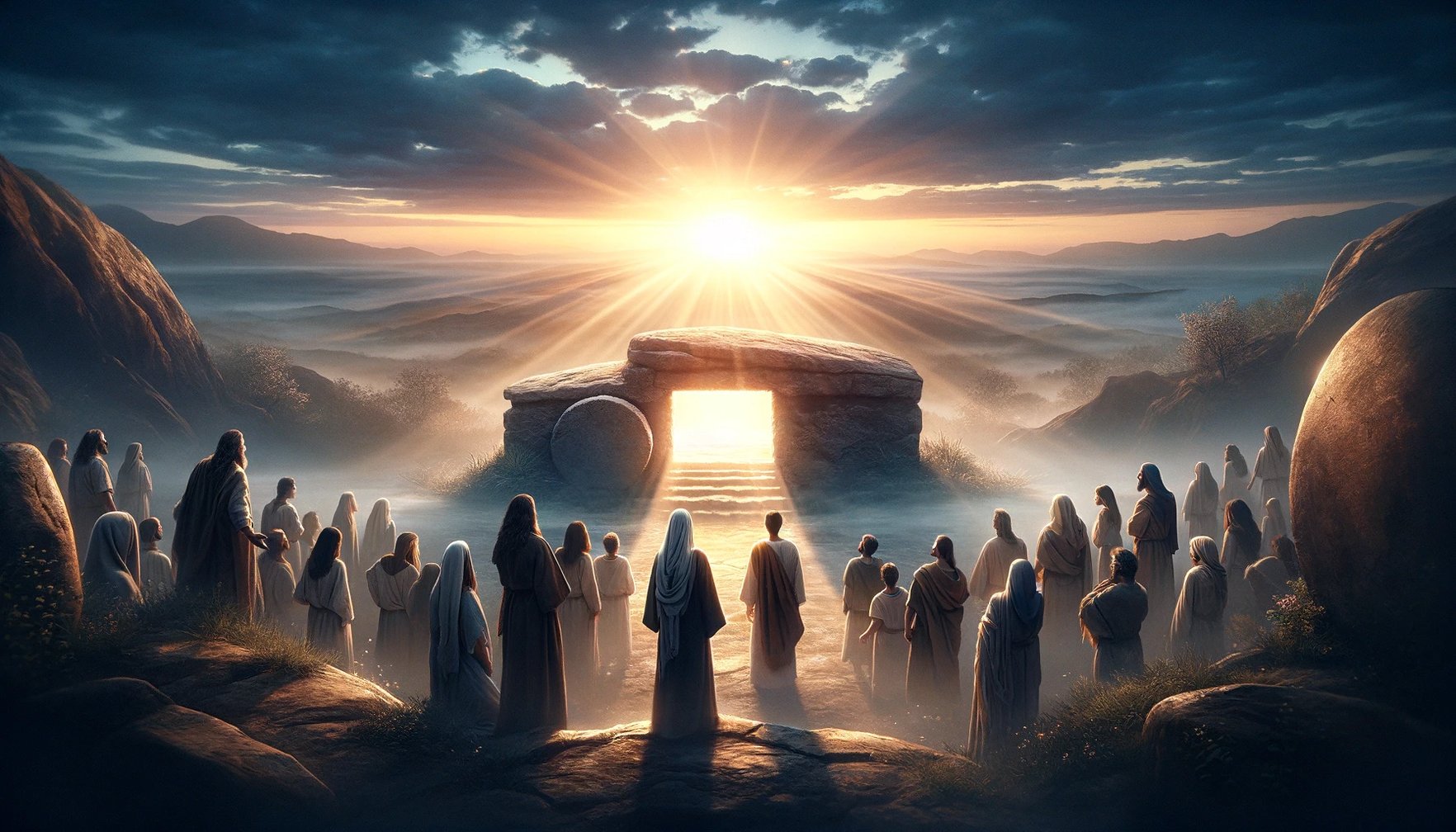
The resurrection of the Lord Jesus Christ is fabulously rich in meaning, for which reason it occupied a central place in the apostolic preaching. We can see this richness in the way it points both back and ahead, and also in what is says to all with ears to hear.

The resurrection looks back to Christ’s righteous life and atoning death on the Cross, through which, by his active and passive obedience, He fulfilled all the righteous requirements of the Law in behalf of His people, and so secured, once and for all for all who believe, the forgiveness of their sins, the imputation of His righteousness, and God’s gift of eternal life.

It looks ahead to what His life and death purchased: the effusion of divine life out of heaven and into the fallen world-system, an effusion that began on the Day of Pentecost and has continued to the present, as sinners hear the Gospel, believe its message, call upon Christ for salvation, and welcome the Living One into their hearts as Lord.

It also looks ahead to the resurrection of the dead on the Day of Christ, when He comes again to raise the dead, judge the world in righteousness, turn the unrepentant and unbelieving into Gehenna, and create glorious new heavens and a new earth, the eternal home of the triune God, all the holy angels, and all the saints.

The Resurrection also speaks, saying that the curse which fell upon man and nature at Adam’s fall, and also the curse which falls upon all who break God’s holy Law, have both been broken, once and for all, for all who believe.

And it further says that the ruler of the present fallen world-system—who is Satan and his evil angels—has been cast out of his former place of authority, and is henceforth giving place to the world’s rightful Ruler: the High King of Heaven, the Lord Jesus Christ, who, more and more, rules in more and more hearts, and who will cast out all evil, once and for all, at His return in glory.

“Father, may You enable us so to look and so to hear that we may rise to the newness of life that is found in Your risen Son, in whose name I pray.” Amen.


In the Great Scheme of Things . . .

It is normal to be healthy, abnormal to be sick, injured, or in pain.

It is normal to be happy, abnormal to be sorrowful or depressed.

It is normal to be holy, abnormal to be bound and twisted by sin.

It was normal for Adam and Eve to be healthy, happy, and holy in the Garden of Eden.

It is normal for some people, in some measure, some of the time, to be some of these things in the mixed-up world bequeathed to us by the first Adam when he fell, but also by the last (and greater) Adam, now that he has risen from the dead.

It will be normal for all people, to be all of these things, in full measure, all of the time, in the perfect world soon to be bequeathed to us (who believe) by the last Adam at his return in glory.

And it is normal for us who know these things to find eternal comfort and good hope in them, and to keep on sharing this glorious hope with everyone we love.

Then Jacob was left alone, and a man wrestled with him until daybreak . . .
And the man said, “Let me go, for the dawn is breaking.”
But Jacob said, “I will not let you go unless you bless me.”
(Genesis 32:24-32)

Then they sent out Barnabas as far as Antioch,
who, when he had arrived and seen the grace of God, was glad;
and he exhorted them all, that with purpose of heart
they should cleave to the Lord.
(Acts 11:22-23)

For no one can lay a foundation other than the one already laid, which is Jesus Christ.
Now if someone builds on this foundation with gold, silver, or precious stones, or with wood, hay, or straw, 
the quality of each one’s work will become evident, for the Day will bring it to light.
(1 Cor. 3:11-13)

But all of us, with unveiled faces,
beholding as in a mirror the glory of the Lord,
are being transformed into the same image
from one degree of glory to the next;
and this comes from the Lord, who is the Spirit.
(2 Cor. 3:18)

Learning to lean, learning to lean,
I’m learning to lean on Jesus;
finding more power than I’d ever dreamed,
learning to lean on Jesus

The Lord thy God in the midst of thee is mighty.
(Zeph. 3:17) 


A few years back, while making my way through the gospels, I noticed something interesting: Over and again I was coming upon Christ in the midst of various persons, places, things, or events. And so, like Moses of old, I decided to turn aside and see this great sight: the many different ways in which our God had placed his Son in the midst, and the lessons we might learn from them.

Here is something of what I saw.

I. Seeing Christ in the Midst

As a boy, Jesus was accidentally separated from his father and mother during the Passover observances in Jerusalem. When the distraught parents finally found him, there he was, seated in the temple, in the midst of the scribes and Pharisees, all of whom were marveling at his wisdom (Luke 2:46-47). Pondering this, I saw that God would have us emulate those Jewish leaders, since even now Christ is in our midst and teaching in the temple daily (Luke 19:47; 24:43-45).

As a grown man, the Lord embarked on an evangelistic ministry to his fellow Israelites, proclaiming the good news of the nearness of the Kingdom, and calling all to repentance from sin and faith in him. In partial fulfillment of that ministry, God granted him to perform miraculous signs and wonders in their midst (Acts 2:22). Reflecting on this, we soon realize that Christ has never ceased to perform such wonders, though in our day his miracles are primarily spiritual, yet far more numerous and far more important than the physical (John 14:12; 1 Cor. 15:46; Eph. 1:3, 15-21).

When teaching his disciples about prayer, the Lord told them that where two or three are gathered in his name, there he is in the midst of them (Matt. 18:20). Here we learn to prioritize prayer with the family of God, and also to seek the Spirit’s gift of agreement in prayer, so that we may enjoy, not only a richer sense of the Lord’s presence, but also faith-building answers to our Spirit-led petitions (Matt. 18:19-20; Acts 4:23-31; 1 John 5:14).

The apostle John relates that in the midst of the Feast of Tabernacles Jesus entered the temple courts and began to teach the people, after which he cried out to them, offering his Jewish kinsmen the true water of life, typified by the water that Moses gave God’s people during the days of their wilderness wanderings (Num. 20:1-8; John 7:14). This teaches us that Christ dwells not only in the midst of the Feast of Tabernacles as its true meaning and fulfillment, but also in the midst of all the other Jewish feasts. And if we listen carefully as he teaches in the temple daily, we will find that he shows us the meaning of those feasts as well (Matt. 5:17; Col. 2:17).

Later on, the same apostle tells us that when the last of the convicted scribes and Pharisees had slunk away, Jesus and the woman caught in adultery were left alone in the midst: presumably of a large crowd which had seen, heard, and (in some cases) been stung by his wisdom, compassion, and mercy (John 8:9). Here we learn that not only the Lord, but also the world itself, is always watching to see how we will relate to sinners: whether in a proud, legalistic spirit that is eager to mete out judgment, or in a humble, gracious spirit that is eager to pour out mercy and grace, albeit never at the expense of truth or holiness (John 8:1-11; 2 Tim. 2:24-26).

On the Mount of Transfiguration—where Peter, James, and John received a sneak preview of the Kingdom of God when it has come in power—the radiant Christ once again appeared in the midst, this time between Moses and Elijah. The former represented the Law, the latter the Prophets, and the two together the entire body of Old Testament (OT) revelation. Accordingly, when Peter sought to treat them as equals by making identical tents for all three, God swiftly disabused him of the idea, declaring to the terrified disciples, “This is My beloved Son, my chosen One. Listen to Him!” (Luke 9:34–36). Here we learn that the Lord Jesus, under a many-colored veil of types and shadows, is the true center of the entire OT; that he alone can open up its meaning to us; and that we should therefore diligently listen to him, especially in the New Testament, where, by the illuminating work of his Spirit, he himself has given us the keys to the Old, and so removes the veil once and for all (Luke 24:44-45; John 5:39; 2 Cor. 3:12-18).

When he was brought to trial before his enemies—Caiaphas, Annas, Pilate, Herod, and the Roman cohort—the Lord stood in their midst with quiet strength and dignity, speaking, testifying, and/or holding his peace as his Father led, and all the while humbly submitting to whatever evil-doings God himself had fore-ordained him to endure (Is. 53:7; Matt. 26:47-27:31; Acts 4:27-31). Here we are taught, viscerally, that in the midst of inevitable persecutions God himself, by his Spirit, will be present in our own midst, guarding against fear, anger, hatred, threat, and vilification, but instead supplying all needed courage, strength, wisdom, love, mercy, and grace (Acts 7:54-60; Rom. 12:14-20; 1 Pet. 2:21-25; Rev. 1:9).

When the mockery of a trial—and the trials of mockery—had all run their course, the Roman authorities nailed Jesus to a cross, and two other criminals with him: one on either side, and Jesus in the midst (John 19:18). And though at the outset both of the criminals reviled him, one of the two—observing the Lord’s faith and marveling at his words—suddenly caught a glimpse of the Messianic King that he really was. And so—moved by gifts of illumination, penitence, and faith—he humbly made his request: “Jesus, remember me when you come again in your royal power” (Luke 23:42). And he was heard. From this we learn that the crucified Christ—like the God-imbued pillar that stood by night between Pharaoh’s army and the Israelite nation at the Red Sea—is light, hope, and salvation to all who are graced to see, repent, and trust, but darkness, foolishness, and death to those who are not, and who therefore persist to the end in willful blindness and stubborn unbelief.  And recalling that we ourselves were once like the latter but graciously made to be like the former, we learn to worship the Lord with fear, rejoice with trembling, and cling to him in gratitude, love, and every-deepening purpose of heart (Ex. 14:1-20; Psalm 2:11; John 3:19; 7:43; 9:16; 10:19; Acts 13:22-23; Rom. 9:14-24; 2 Cor. 2:14-17; Titus 3:3-7).

After his resurrection, the Lord appeared, not once, but several times, in the midst of his disciples (Luke 24:36; John 20:19, 26). Thus did he teach us to expect him to be present and active in our gatherings, and therefore not to be like doubting Thomas, who missed the precious appearing because of stubborn unbelief (John 20:26-29).

After the Lord’s ascension, God granted his exiled apostle a stupendous vision of the glorified Christ standing in the midst of seven golden candlesticks and walking about among them (Rev. 1:13, 2:1). Here again we see that, by his Spirit, the Head of the universal Church is present and active in every one of its local incarnations, lovingly inspecting, commending, encouraging, exhorting, reproving, warning, and issuing promises to all who name his name, even to those who (thus far) have refused to let him in (Rev. 3:20). Knowing this, both leaders and laity are exhorted always to believe in his presence, listen for his voice, and faithfully love, serve, defend, and seek to purify the Church that their Lord purchased with his own blood (Acts 20:17-31; Rev. 5:9).

In a subsequent vision of heaven above, John saw a Lamb, as if previously slain, standing in the midst, between the 24 elders and the throne of God (Rev. 5:6). Here we behold—and are taught to trust in—the one Mediator between God and man: the God-man, Christ Jesus, whose finished work on earth purchased the salvation of his people; who, as the High King of heaven, administers that salvation to his people; and who, as the High Priest of heaven, ever lives to make intercession for his people, thereby anchoring them securely and eternally in heavenly places (John 6:40; 10:16; 1 Tim. 2:5; Heb. 7:25; Rev. 21:1-4).

Finally, Scripture also reveals that on the day of his return—when the heavens and the earth shall flee for safety from before his face—Christ will be seated on his throne in the midst of the physical universe itself. He also will be seated in the midst of the sheep and the goats, there to judge the world in righteousness, turn the rebellious into Gehenna, recreate the cosmos, and descend with his beloved Bride to a regenerated earth, where, together with the Father, the Spirit, and all the holy angels, he and she will forever dwell in the midst of a glorious new world to come (Matt. 24:29–31; Rev. 20:11–15; 21:1-26).


II. Placing Christ in the Midst

In all these biblical scenes our heavenly Father is clearly speaking to us. He is bidding us to stop, draw near, ponder, and inquire: Why do we keep seeing Christ in the midst? Happily, in later and more doctrinal portions of his Word, he gives us further light, revealing that it belongs essentially to his eternal purpose for the universe, life, and man that his beloved Son should dwell in the midst—at the absolute center—of all things. And there is more. For it is this—God’s will of purpose for the universe—that determines his will of precept for us, his dear children. In other words, the more we become aware of God’s eternal, Christ-centered purpose and plan for the universe, the more natural it will be for us—in both our personal and corporate Christian experience—to place and keep the Lord Jesus Christ at the center of all things.

In what follows, I want briefly to touch on seven such things.

First, our heavenly Father desires that Christ should dwell at the center of our being.

From the beginning, this was God’s purpose for mankind. Throughout the probation in Eden, he offered eternal life to Adam and his seed. Adam had only to partake of the fruit of the Tree of Life, and the Son of God, by the Spirit of God, would have taken up residence in his heart once and for all; that is, at the center of his being. The Son would then have become Head and Ruler over Adam and his kin, working in and through the growing family of man to fulfill the Father’s manifold historical purposes for the race, and continuing to do so until that happy day when he (the Son) would have glorified the world and then delivered it up as an eternal kingdom to his Father, so that God might be all in all (Hab. 2:14; Rom. 8:18-25; 1 Cor. 15:20-28; Eph. 1:10; Col. 3:4).

But it was not to be. There came the fall, and with the fall, the fall of all human hearts, which became hearts of stone; hearts dead in trespasses and sins; hearts under the dominion of the world, the flesh, and the devil; hearts in desperate need of redemption, which is to say, rescue from the manifold consequences of sin, and restoration to God’s eternal, Christ-centered purpose for the universe, life, and man (Ezek. 36:26; Mark 7:20-22; Eph. 2:1-3).

But where sin abounded, grace abounded much more. Through the redemptive work of the last Adam, the sinful work of the first Adam was overcome, and the original purpose of God for his creation reclaimed and restored. Therefore, by receiving the Spirit of Christ into our midst, we now may have hearts of flesh, hearts alive to God, hearts resting comfortably under the dominion of the High King of heaven, hearts ushered—gratefully, gladly, and worshipfully—into the presence of his God and Father, and hearts eagerly awaiting that happy day when Christ will come again: when all things are headed up under him; when the earth is filled with the knowledge of the glory of the LORD as the waters cover the sea; when the Lord of glory delivers up the glorified kingdom—the redeemed universe, life, and man—to his heavenly Father, so that, just as he had planned, God may be all in all (Hab. 2:14; Matt. 13:38-43; Rom. 8:18-25; 1 Cor. 15:20-28).

This cosmic miracle, which began on the Day of Pentecost, begins afresh each time a sinner is born from above: when he beholds his need, cries out to Christ for mercy and life, receives him as Lord into the midst of his heart, and, by water baptism, is also received into the midst of the Lord’s people (John 1:12; Acts 2; Rom. 10:5-13; 1 Cor. 12:13). It progresses as the life of Christ, through sanctification, radiates outward from his midst, ever-increasingly pervading each faculty, inclination, thought, word, and deed. And it culminates at Christ’s return, when the life and light in each saint flares up into glory and henceforth comes to dwell at the center of all things: when Christ, in glory—to the delight of his God and Father—is now fully set in the midst of the universe, life, and man (Matt. 5:14-15; 6:22; Phil. 2:15; Rev. 21:23-24; 22:5).

Secondly, our heavenly Father desires that Christ should dwell at the center of our worldview.

The Spirit of Christ in the midst of human hearts entails the Spirit of Christ in the midst of all human faculties, including our understanding. And since it has pleased our Father to place Christ in the midst of his eternal purpose and plan, we who have received the Father’s Spirit must faithfully watch him work—and diligently work with him—at placing Christ in the midst of our understanding of his purpose and plans. In other words, God is calling his children to co-labor with him so that Jesus Christ, ever-increasingly, will be seen to reside at the heart of their worldview.

What exactly is a worldview? Having pondered this question for many years, I have finally concluded that a worldview consists of the answers we give to nine fundamental, God-implanted questions of life.

They are: (1) What is the ultimate reality, the source of the universe and all that is in it? (2) What is the origin of the universe, life, and man—and of any other worlds or dimensions that may exist? (3) Do the universe, life, and man have a purpose or meaning; and if so, what is it? (4) What, if anything, went wrong? Why are evil, suffering, and death so painfully present in the world? (5) What, if anything, can be done about them; and by whom must it be done? (6) How shall we live? What, if any, are the proper motives and standards of conduct for men and nations? (7) What happens when we die? (8) Where is history heading? Does the universe have a goal or destiny; and if so, what is it? (9) Can we know with certainty the true answers to the questions of life; and if so, how? Over and again in their quest for religious and philosophical truth, men and nations have sought (and frequently invented) answers to these nine existentially urgent questions of life.1

Now, recall for a moment the miracle of healing that our Lord performed upon a certain blind man from Bethsaida. After escorting him out of the town, he stood the man before him, spat into eyes, and asked him, “Do you see anything?” The man replied, “I know I’m seeing men, because they look like walking trees!” So the Lord ministered to him once again, this time placing his hands on the blind man’s eyes; and now the man was completely healed and could see all things clearly (Mark 8:22-36).

This, metaphorically speaking, is the story of every Christian’s worldview. Our new spiritual life began with a gift of seeing, so that suddenly we beheld—with a saving measure of clarity—the Person and Work of Christ, and their implications for our life. But from the very beginning we also saw that we were only seeing in part—that what we were seeing, we were seeing dimly; and that there were many other things we were not seeing at all. This fact of spiritual life—this sense of partial spiritual blindness—gave birth to a great longing for further healing, broader vision, and clearer sight, all of which we knew were waiting for us in the Word of God. And so—in time, through prayer, by persistent meditation upon the Scriptures, and by the illuminating work of the Spirit—the Lord satisfied our longing, so that now we can indeed see all things clearly . . . and yet are longing for further clarity still!

The “all things” we are being given to see include, very prominently, the answers to the nine questions of life. Indeed, as we are drawn more deeply into the thought-world of the Bible, we soon realize that our heavenly Father has graciously spoken to each and every one of these questions, and that his answers comprise the sum and substance of his great biblical revelation to the world.

But more even than that, we also realize that he has set the Person and Work of his Son in the midst of every one of those answers!

Such seeing has begotten centuries of theological reflection, with the teachers of the Church probing and placarding the various ways in which Jesus Christ dwells in the midst:  (1) of the ultimate reality, as the One dwelling in the midst of the triune Father-Son-Holy Spirit; (2) of the origin of the universe, life, and man, as the One through whom all three were created; (3) of the purpose of the universe, life, and man, as the One for whom all three were created; (4) of the truth about what went wrong, as the One who revealed the sinful work of the first Adam, through whom (with a culpable assist from Satan) all evil, suffering, and death entered the world; (5) of the truth about what can be done, as the One who revealed the righteous work of the Last Adam, through whom alone (with a gracious assist from the Father and the Spirit) evil, suffering, and death is to be expelled from the world, and the glory of God brought into it; (6) of the way we should live, as the One who revealed the Law of the Spirit of life in Christ Jesus, and the One through whom alone obedience to that Law is now possible, available, commanded, and proclaimed in the gospel; (7) of the truth about the afterlife, as the One who revealed both heaven and hades, opened heaven to all who believe, and (together with the Father and the Spirit) is heaven’s chief joy; (8) of the truth about the goal of universal history, as the One who, at his coming, will be the divine Agent of the Consummation: of the Resurrection, the Judgment, the fiery destruction of the present cosmos, and the creation of a glorious new Cosmos to Come; (9) and of God’s definitive answers to all the questions of life, as the One through whom the answers were given to us—through his apostles and in the New Testament—and by whose Spirit they are illumined, integrated, and rendered operative in our hearts and lives (Luke 24:13-49; John 16:12-15; Acts 2:14-36; 1 Cor. 2:1-2; Eph. 3:3-5; 2 Thess. 2:15; 2 Pet. 3:3-13; Jude 1:3).

In sum, by giving us, through his Son, all the answers to all the questions of life, our heavenly Father has given us the one true world-view. And when we no longer see men like walking trees, but see all things clearly, we also see that Jesus Christ lives and shines in the midst of them all.

Thirdly, our heavenly Father desires that Christ should dwell at the center of our affections.

When Christ comes to dwell in our midst, his life not only permeates and transforms our understanding, but also our affections. To the stone-hearted Pharisees, our Lord said, “I know you, that you do not have the love of God within you,” and, “If God were your Father, you would love me, for I went forth from God, and now am present among you” (John 5:42; 8:42). Those who are granted a new heart of flesh receive a new set of passions, a new set of loves (Ezek. 36:25-27; 2 Cor. 3:2-4; 5:14).2

But is it really true that our heavenly Father desires his Son to dwell at the center of our affections; to be, as it were, the master passion of all our new passions? For those who love the triune God, this affirmation will seem problematic, since, being equally divine, all three Persons of the Trinity are equally worthy of our affection.

And yet Scripture itself seems clearly to point us in this direction. For there we learn that the Father desires all his human creatures to love and honor the Son just as they honor him, and that to this end he has bestowed upon him all manner of divine prerogatives in the economy of creation, providence, judgment, and redemption. Moreover, in fulfillment of this purpose, the Holy Spirit not only unveils to those same creatures the manifold glories of the Son, but also redemptively draws them to him, showing them that the Father has been pleased to make his Son the divine treasure-trove in whom alone may be found all the gifts, graces, and blessings that he (the Father) has in store for fallen mankind (John 5:23; 6:27; 13:3; 16:13-15; 1 Cor. 1:30; Col. 1:15-20; 2:3; Heb. 1:1-4).

And just here we tread upon especially holy ground, since the Son-centeredness of the Father’s decrees would seem clearly to intimate and reflect something more, something profound, something that we cannot fully see or understand: an eternal Son-centeredness existing within the trinitarian life itself. For Scripture reveals, on the one hand, that in eternity the Father is ever begetting, knowing, loving, and delighting in his Son, who, we may safely assume, is uniquely begotten in the image of his Father; and that the Son, in turn, is ever knowing, loving, and delighting in the Father who ever begets him, and therefore (in the economy of redemptive history) ever seeking to glorify the Father as the Greatest One (John 10:18, 29; 14:28).

On the other hand, Scripture also reveals that the Holy Spirit is at once the Spirit of the Father and the Spirit of the Son, for which reason theologians in the West have deduced that the Spirit proceeds both from the Father and the Son. This, in turn, suggests that in eternity both the Father and the Son are pleased to breathe out the third Person of the Holy Family, whose eternal mission, so to speak, is to contemplate, reveal, and administer the riches of the love relationship of the Father and the Son to the saints and angels, who, in eternity, are ever-present with the triune God by divine decree (Prov. 8:30; John 1:18; 10:29; 12:28; 15:26; 14:16-18, 28; Rom. 15:9; 1 Cor. 2:6-13; Gal. 4:6; Phil. 2:11).

Now if all this is true, may we not conclude that, in accordance with the eternal will of the triune God, the Holy Spirit is ever intent on unveiling the Son as the central Person in the Trinity, and the Father as the supreme Person in the Trinity?

If so, it is both natural and fitting that the exalted Christ should become the center of the Christian’s affections. Once again, the Scriptures seem clearly to support this thesis. For it was to him that the Father and the Spirit first drew us (John 6:44; 16:8-11). It was in his face, in his work, and upon his Cross that we first beheld the glory of God; and, after crying out to him, it was in his embrace that we first tasted and saw that the Lord is good (John 12:32; 16:5-11; 1 Cor. 1:23; 2:2; 2 Cor. 4:6; 1 Pet. 2:3). It was he who became our first love (though not our only love) (Rev. 2:4). And in the mysterious rhythms of our new spiritual life within the triune Godhead, it is to the Person and Work of Christ that the Father and the Spirit return us again and again for fresh infusions of divine life and ministry (Matt. 11:27; 17:5; John 4:10; 5:39; 6:45; Acts 3:19).

The eye that is fixed on Christ—the author and perfecter of our faith—will behold the Father and the Spirit as well (Matt. 11:27-28; Heb. 12:2). The heart that is fixed on Christ—humbly, prayerfully, needfully cultivating a deeper and deeper affection for the exalted Lord—will, in like manner, come to love the Father, the Spirit, the saints, the holy angels, and the world of lost sinners (Matt. 11:27; John 3:16; Acts 2:33; Gal. 4:6; 1 Thess. 4:9). As Christ dwells at the center of our affections, we will watch—in wonder, gratitude, and joy—as the circumference of our affections continually expands, radiating upward and outward, finally to include all things (1 Cor. 3:22-23).

Let us therefore most heartily resolve never to depart from our first love, but instead to nourish it daily through prayer, Bible meditation, Spirit-led thanksgiving, praise, adoration, prayers, and implicit obedience to all the Lord’s wise commands, which are not burdensome, but which, through our obedience, carry us ever deeper into presence and purposes of his God and our God, of his Father and our Father (Psalm 63:8; Matt. 11:29; John 14:15; 20:17).3

Fourthly, our heavenly Father desires that Christ should dwell at the center of our service of worship.

When a child of God is born again, he is born into a life of eternal worship. In and through his great High Priest, Jesus Christ, he is henceforth called to serve both God and man as a member of the royal priesthood that is the Church (1 Pet. 2:9).

My focus here is upon the worship of the Church Militant, the full round of spiritual services to which the saints on earth are called as they make their pilgrim way through the wilderness of this present evil age to the Promised Land: the full spectrum of spiritual sacrifices—ministries—by which God’s holy priesthood demonstrates the surpassing worth that it attaches to its triune Creator, Redeemer, and Lord, and his people (1 Pet. 2:4-6).

These ministries—or forms of worship—fall nicely into three basic categories: upward, inward, and outward.

Upward ministry is conducted in our personal devotions, small group gatherings, and all-church worship on the Lord’s Day, and is directed to God above. It is possible because the saints, by being in Christ, are now seated above; it is actual whenever the saints, on the wings of the Spirit, draw near (and seek to draw nearer) to the Three-in-One who dwells above (Eph. 1:20; 2:6; Heb. 4:16; 10:22; James 4:8; Rev. 4-5).

Upward ministry is two-fold. On the one hand, it consists of outpourings of thanksgiving, praise, and adoration, empowered by the Spirit and inspired by the contemplation of gospel blessings heralded in Word and Sacrament. On the other hand, it consists of various petitions inspired by a sense of deep need, and offered through Christ to the Fountainhead of all mercy, grace, healing, wisdom, strength, life, and joy . . . to the great Meeter of All Needs (John 16:23-28; Col. 1:3-7; Heb. 4:16; 1 Peter 2:6; Rev. 12:14).

By its very nature, upward worship is Christ-centered. For on the one hand, it is the Spirit of the Son, dwelling in the midst of God’s adopted sons and daughters, who empowers them to come before the throne of grace, crying, “Abba, Father!” (John 16:23-24; Rom. 8:15; Gal. 4:6; Heb. 2:11-13). On the other, it is the Spirit of the Father who in turn directs their attention to his supreme gift, reminding them that it is only in and through his uniquely-begotten Son that heaven’s gifts are now theirs to celebrate, savor, and diligently pursue (John 4:10; 6:27; Rom. 12:11; 1 Cor. 1:29-31; 2 Cor. 9:15; Col. 2:3; 3:1; Heb. 11:6). Just as the saints cannot have the Father without having the Son, so too they cannot worship the Father without worshiping the Son, through whom alone they come to the Father  (John 14:6; 1 John 5:12).

Revelation 5—a text that vividly depicts the eternal, Christ-centered worship of all God’s holy ones—embodies this truth and makes it plain:

Then I looked, and I heard the voice of many angels around the throne, and the voice of the living creatures and the elders. And in number the angels were myriads of myriads, and thousands of thousands; and with a loud voice they all were saying, “Worthy is the Lamb who was slain, to receive power and riches and wisdom and strength and honor and glory and praise!” And I heard every created thing in heaven and on the earth and under the earth and on the sea—and all that is within them—saying, “To the One who is seated upon the throne, and to the Lamb, be praise and honor and glory and dominion forever and ever!” And the four living creatures kept on saying, “Amen!” And the elders fell down and worshiped. – Revelation 5:11-14

Here we see that the worship of heaven is not exclusively of Christ, nor even primarily of Christ; but it is indeed centered on Christ, having been purchased by Christ, and ever after offered through Christ to the God and Father of all.

Inward ministry consists of spiritual ministry flowing down out of heaven, through the saints, to the saints; that is, into the Church. It is rightly considered a species of worship since those who engage in it demonstrate the great worth they attach to God’s people, and to God’s great purpose for his people: that he himself, through the exercise of his people’s spiritual gifts, should edify, sanctify, and (ultimately) glorify the Bride and Body of his Son, which is also the eternal human family of God the Father (Rom. 8:28-30; 12:1-8; 1 Cor. 14:26; Eph. 4:11-13).

When we carefully consider this form of worship, we soon realize that it too is profoundly Christ-centered. For in the end, the thrust of all God’s spiritual gifts is to direct (or redirect) believers to the all-sufficient, God-given treasure-trove that is Jesus Christ. They are to come to him, commune with him, contemplate him (both his Person and Work), converse with him, and constantly draw upon him (and the Father), by faith, for all their every need.

Why so? The NT answers fulsomely. It is so that in this process, Christ may be formed in each one (Gal. 4:19); so that each one may be transformed by the renewing of his mind (Rom. 12:1-2); so that each one may be conformed to the image of Christ (Rom. 8:29); so that in that day, when the Church is revealed in all her glory, all will see that she is indeed the very Body and Bride of the glorified Christ, the fullness of him who fills all in all (Eph. 1:23; Col. 3:1-2).

In the final chapters of the Revelation we learn that the Bridal City (i.e., the glorified Church of Christ), being filled with the light of Christ, will be the lamp that gives light to all the nations of the redeemed. In the exercise of our spiritual gifts—in the performance of our acts of inward worship—we do well to keep this great hope in view, and therefore, like the apostle, to travail in the exercise of our gifts, so that Christ may be (further) formed in all, his glory (further) imparted to all, and his glory (further) flowing through all (John 17:24; Gal. 4:19; Phil. 2:15; Col. 2:1-3; Rev. 21:1-27).

Outward ministry, like inward, also flows down from heaven and through the Church, but this time out into the world of our unbelieving neighbors. It too is an act of worship, since it reflects the immeasurable value that our heavenly Father attaches to the lives of all his image-bearers; but more than that, the immeasurable value that both he and the Church attach to the joys of eternal life—the saving knowledge of God and Christ—offered to the whole world in the gospel of Christ (John 17:1-3).

This gospel—including the verbal proclamation by which the Spirit administers it to beloved sinners (and saints)—is altogether Christ-centered.  In the words of the apostle Paul, the Church Militant is evangelistically “. . . separated to the gospel of God, which he promised beforehand through his prophets in the Holy Scriptures, and which centers around his Son” (Rom. 1:1-4). As the saints reach out, it is Christ’s love that they desire their neighbors to experience, Christ’s truth that they desire them to believe, and Christ’s Person and Work that they desire them to receive, unto the salvation of their souls (John 1:12; 2 Cor. 5:20-21; Col. 1:28; Rev. 22:17).

Notably, we observe this same Christ-centeredness in the redemptive work of each Person of the Trinity, as they co-labor, through the Church’s proclamation of the gospel, to bring God’s elect to illumination, repentance, and faith: The Father draws all (his children) to Christ (John 6:44), the Son brings all (his sheep) to Christ (John 10:16), and the Holy Spirit convicts all (sinners) of their need for Christ (John 3:5-8; 12:32; 16:8-11).

Not all Christians will have a gift of evangelism, but all Christians, by God’s grace, will have savingly beheld the Son and believed on him for eternal life (John 6:40). And all Christians, by God’s good providence, will have precious opportunities to testify about what they have seen (Luke 21:12-15; Acts 1:8; Rev. 12:17). Such testimony—such outward ministry—will be deeply Christ-centered: inspired by Christ, focused on Christ, leading to Christ. And it is a wise disciple who is intentional about keeping things that way (1 Cor. 2:1-5; Rev. 19:10).

Fifthly, our heavenly Father desires that Christ should dwell at the center of our self-understanding.

Prior to our conversion, our sense of identity—our self-understanding—was anchored to this present world, whether to our religious culture, family culture, national culture, endowments, work, accomplishments, reputation, etc. But at our conversion we were lifted out of this present world, seated in heavenly places, and granted a new identity in Christ (Eph. 2:5-7; Col. 1:13). Accordingly, our subsequent growth in Christ involves an increasing—and increasingly thrilling—discovery of who we are in him, and of all that is ours by being in him.

The imagery and theology by which the NT would have us to think about our new identity is fabulously rich, and therefore beyond the limits of these few paragraphs. However, the essentials are well within reach.

Again, when the Holy Spirit drew us to Christ, he granted us illumination, repentance, and faith, all of which culminated in our calling on the Lord for salvation. This resulted, first of all, in our justification, which includes the forgiveness of our sins (owing to Christ’s passive obedience on the Cross), the imputation of Christ’s righteousness (owing to his active obedience throughout his entire life), and the final result: the Father’s judicial declaration that now we are perfectly righteous before his Law and in his sight, since now we are clothed, through faith, with the perfect righteousness of Christ himself (Zech. 3:1-5; Acts 2:27; 16:30; 2 Cor. 5:21; Eph. 1:18; Phil. 3:9).

But there is more, much more. For through our justification we were reconciled to God, so that he is no longer angry with us, and we no longer hostile to him; through our reconciliation we were adopted by God, so that we are no longer children of Adam and Satan, but of God; and through our adoption we were definitively sanctified (i.e., separated) to God as his eternally beloved family, people, nation, and holy priesthood. And more even than this, in time we come to realize that long before our conversion to Christ we were chosen in him in eternity past, predestined to be conformed to his image, and redeemed by him at the Cross, so that now we may be certain that God will preserve us in Christ to the end of our lives, receive us into heaven upon our death, and raise and glorify us bodily at his Son’s return.

In sum, because of our God-given faith in the Person and Work of Christ, we are learning to think of ourselves as eternally beloved, chosen, redeemed, called, justified, reconciled, adopted, and sanctified sons (or daughters) of God, forever sealed by and in the Holy Spirit, and forever seated with/in Christ (the Son) in heavenly places, whether in heaven up above, or in the new heaven and the new earth up ahead  (Rom. 5:10; 8:15, 28-30; 1 Cor. 6:11; Eph. 1:13; 2:6; 4:30; 1 Pet. 2:10).

A lively, Spirit-wrought sense of this, our astonishing new identity in Christ, is the holy ground out of which spring forth all manner of spiritual blessings.

For example, in this new identity we see that we are eternally secure in the Father’s love and acceptance; indeed, as secure as the Son himself, since now, by God’s grace, he has transferred us once and for all out of the first Adam and into the Last, out of death and into life, out of the domain of darkness and into the eternal kingdom of his beloved Son (John 5:24; 10:27-30; Rom. 5:12-21; 8:31-39; Col. 1:13).

Similarly, we see that God is no longer angry with us, nor will he ever be angry again (though he might, at times, be displeased), since his Son, at the Cross, absorbed all the divine anger aroused by our sins, in order that we might absorb (and henceforth be compelled by) the steadfast love that moved him to send his Son into the world on our behalf (Isaiah 12:1-5; Ezek. 20:33-34; John 3:16; Rom. 3:25; 2 Cor. 5:14; Heb. 12:4-11; 1 John 2:2).

Very importantly, we see that, being predestined to conformity with God’s Son, we also are predestined to walking in the footsteps of his Son. In other words, it pleases our heavenly Father to make the course of his Son’s human life a pattern for the course of our own. Of necessity, the Last Adam must walk in the footsteps of the first Adam, though not in failure, but in complete victory; of a similar necessity, the children of God must walk in the footsteps of the Last Adam, and, despite occasional failures, in final victory.

The steps in this walk are many, and experienced by these children in a variety of times and ways, but the essential pattern is the same for all. Jesus was born physically; we are born physically. Jesus was born spiritually; we are re-born spiritually. Jesus was baptized and anointed for ministry; we are baptized and anointed for ministry. Jesus was thrust into the wilderness, there to be tested by God, tempted by the devil, and triumph by Word and Spirit; we too are thrust into a wilderness, there to be tested, tempted, and triumph by Word and Spirit. Afterwards, Jesus returned in the power of the Spirit, embarked upon his ministry, and went about exercising spiritual gifts, doing good, preaching the gospel, making friends, and encountering enemies; we ourselves, in a lesser measure, will do and experience the same. At the end of his course, and in a manner unique to himself, Jesus died, glorifying God and redeeming lost sinners; at the end of our course, in a manner unique to ourselves, we too (we fervently hope) will do the same. After his death and burial, Jesus rose again, ascended into heaven, and sat down at his Father’s right hand, there to exercise all authority in heaven and earth; at different times, in different ways, and always under his authority, we will do the same. And when Christ, who is our life, appears in glory in the skies above the earth, we will appear with him in glory. Therefore, in that day it will finally be seen and fully understood that just as the Father ordained the humiliation, exaltation, and eternal glory of his beloved Son, so too did he ordain the humiliation, exaltation, and eternal glory of his Son’s beloved Bride and his own beloved family (Matt. 1:18-25; 3:13-17; Luke 4:1-13, 14-15; John 3:1-21; 14:1-4; 20:19-23; Acts 2:22-26; 10:38; Phil. 2:5-11; Col. 3:1-3; 1 Thess. 4:13-18; Rev. 12:7-17).

Finally, we also see that our new identity in Christ entails a new kind of life in Christ; that much like him, we now enjoy the inexpressible privilege, challenge, and joy of walking with God in the Spirit.

But this particular blessing merits a discussion of its own.

Sixthly, our heavenly Father desires that Christ should dwell at the center of our walk in the Spirit.

Just as Christ has purchased for his people a new objective position before God, leading to a new identity and self-understanding, so too has he purchased a new subjective life in God, leading to a life-long walk in the Spirit with the Father and the Son (John 20:21; Rom. 8:1-17; Gal. 5:16-26). This is the glory of the Christian life.

Our Lord—who is set forth in Scripture as the Last Adam, and therefore as the Progenitor, Head, and Prototype of a new and everlasting humanity—perfectly modeled this life for us (Rom. 5:12-20). Born of the Spirit (and of the virgin Mary), indwelt by the Spirit, and anointed and empowered by the Spirit for ministry, he always walked in the Spirit (and in perfect step) with his heavenly Father. Accordingly, he spoke only what he heard his Father saying, and did only what he saw his Father doing (John 5:19; 12:50). While he could indeed speak about himself and from himself, even this was by the Spirit at the prompting of his Father. Thus, when Philip begged of Jesus, “Lord, show us the Father, and that will be enough for us,” Jesus said:

“Have I been with you so long, Philip, and you haven’t come to know me? He who has seen me has seen the Father; so how can you say, ‘Show us the Father’? Don’t you believe that I am in the Father, and the Father is in me? The words I speak to you all, I do not speak on my own initiative; rather, the Father living inside me is performing his works. Believe me when I say that I am in the Father, and the Father is in me; or else believe me for the sake of the works themselves. – John 14:8-11

Because of the Spirit of the Father dwelling in Christ, to see and hear Christ was to see and hear the Father. For those having eyes to see, this was (and is) to behold the glory of God in the face of Jesus Christ (John 1:14; 2 Cor. 4:6; Heb. 1:3).

Again, this is the kind of life to which the triune God calls his people, with all the challenges, blessings, and glorious fruitfulness that he intends to accompany it. Indeed, he offers them no other kind of life. It is the life to which the Father has predestined them, the life that Christ purchased for them, and the life for which the Holy Spirit indwells and empowers them.

At its heart, this is a profoundly Christ-centered life. For, as we saw earlier, God’s pleasure, purpose, and plan from the very beginning has been to see the life of his Son magnified in the universe through his (the Son’s) living in the family of man. And now, through the Son’s redemptive work, the Father’s good pleasure is being realized; for now, by his Spirit, he has set to work forming the life of his beloved Son in each of his beloved sons and daughters (John 14:17; Rom. 8:29; Gal. 4:19). And this entails that just as Christ, in the days of his flesh, abode in the Father by the Holy Spirit, so we, for our part must, must abide in Christ by that same Spirit, and thus enjoy his company, and the Father’s as well (Matt. 11:25-27; John 14:15-21).

As Jesus himself said,

“I am the true vine, and my Father is the vinedresser. Every branch in me that does not bear fruit he takes away; and every branch that does bear fruit he prunes [lit. cleanses], so that it will bear more fruit . . . Abide in me and I in you. Just as a branch cannot bear fruit on its own unless it abides in the vine, so too you cannot bear fruit unless you abide in me. I am the vine, you are the branches. He who abides in me and I in him—he will bear much fruit; for apart from me you can do nothing.” – John 15:1-5

These rich words, which reveal the very essence of Christian life, teach us that by abiding in Christ the Christian will know, love, and abide in the Three-in-One, and the Three-in-One in him. Herein lies the supreme gift of God, Christ, and the gospel: eternal life (John 14:16-21; 17:1-3).

But how, in practice, is such a life to be lived, seeing that the Christian, unlike his Lord, must wrestle with the residual indwelling sin that so easily entangles us, and also with the discipline that this struggle elicits from a perfect Father who would have his children perfectly share in his holiness (Matt. 5:48; John 15:2; Heb. 12:4-17)?

Here, very briefly, are some key NT replies.

Our walk in the Spirit must be pursued . . .

     1. With Christ-centeredness, and this in a three-fold sense: (1) by taking Christ, the perfect Man, as the example and prototype of a person who walks in the Spirit; (2) by daily recalling and celebrating the finished work of Christ, through which alone we have access to the Father and the Son, and through which alone the Spirit has access to us; and (3) by setting our mind on the Spirit of Christ, resolving to walk, as best we can, in tenderness to his manifold infillings and promptings, and therefore in step with him (Matt. 10:20; John 14:6; Rom. 5:2; 8:5; Gal. 5:16; 2 Cor. 3:18; Eph. 2:18; 6:18; Heb. 12:1-2; 1 John 3:2; Jude 1:20).

     2. With restfulness, settling the full weight of our being upon the finished Work of Christ for our standing before God, and also upon the divine Person of Christ (through his Spirit) for our new life in God; and so, by resting upon these two, resolving always to be found by God obeying the Law of the Spirit of life in Christ Jesus, which alone sets us free from the law of sin and death, and which alone enables us joyfully to live and move and having our being in him (Rom. 7:1-8; 8:2, 6; Gal. 5:16; Phil. 3:7-10).

     3. With difficulty, not only because of the residual sin in our members that is hostile to God and that wages war against our pursuit of holiness, but also because of the allure of the world and the devil, both of which appeal to our flesh and seek to prey upon any remaining weaknesses in our understanding, affections, conscience, and will (Rom. 7:14-25; 8:7; Eph. 6:10-17; 1 Pet. 5:8).

     4. With discipline, because God has ordained that his saints will maintain victory over their enemies, smooth and straighten their way, and glorify their Lord by freely choosing to follow hard after him, to lay hold of that for which he has laid hold of them, and to walk closely with him down the rough (but blessed) road to holiness: that is, to maturity in Christ and to a fruitful walk in the Spirit, both of which are developed through faithfulness to the basic disciplines of the Christian life: Spirit-illuminated Bible meditation, Spirit-led prayer, and Spirit-empowered obedience, worship, and charismatically driven service to the church and the world (Psalm 63:8; Matt. 7:24-28; Luke 14:25-33; John 15:8; 1 Cor. 9:24-27; Eph. 2:10; Phil. 3:12-14; 1 Tim. 4:7-9).

     5. With discernment, which is itself one of the most precious fruits of the Christian disciplines, and the means by which the flock of the Lord learns to recognize the voice of its Good Shepherd, approve the things that are excellent, and publicly display what the will of God is: that which is good and pleasing and complete in his sight (John 10:27; Rom. 12:2; Phil. 1:9).

     6. With confidence, seeing that over time, and through discipline and discernment, the Holy Spirit increasingly opens our eyes to the infinite love, kindness, and covenant faithfulness of the God who has chosen us in Christ, extricated us from the world-system, placed us safely in his Son, and brought us (exceedingly) near to himself. This developing knowledge of God’s immutable presence and lovingkindness becomes an anchor for the soul, enabling us to distinguish between the life-giving promptings of the Spirit and the death-dealing promptings of the world, the flesh, and the devil. Does this idea or impression bring life (John 1:4; Rom. 8:2), love (John 15:9; 2 Cor. 5:10), liberty (John 8:36; 2 Cor. 3:17), (godly) longing (John 15:7; Luke 22:15; Rom. 8:26), and/or laughter (John 15:11; 16:24; Phil. 1:25)? If so, and if it is scriptural, it is certainly from the Lord, for we know that the goodness in all such gifts emanates from the goodness of the Giver. And this knowledge makes us bold to shake off any thought or impression that would undermine our confidence in the presence, love, and faithfulness of our God. Truly, such confidence is not easily won, for our enemy is a master of caricature, slander, deception, and intimidation, so that our battle for deep abiding in Christ is long, hot, and heavy. But our supremely confident Lord Jesus Christ has shown us the way, and if only we will follow him our walk in the Spirit, much like his, will grow brighter and brighter unto the perfect day (Prov. 4:18).

     7. With fruitfulness, joy, and glory, because, by walking in the Spirit with our Lord, Christ himself grants us that we should grow in understanding, character, kingdom effectiveness, and his very own love, joy, and peace, with the result that, together with the rest of God’s holy family, we become a city set on a (heavenly) hill, shining brightly in the darkness of this present evil world, beckoning to its weary, hungry, and frightened citizens, and sharing with them the great good news that now, at long last, they can (and must) come home (John 15:1-11; 17:22; Matt. 5:14; Gal. 5:22; Phil. 2:15; Rev. 22:17).

Finally, our heavenly Father desires that Christ should dwell at the center of the Church’s quest for spiritual unity.

In the face of inter-personal conflicts, doctrinal and ethical disputes, and the scandal of Christian denominationalism, the sincere follower of Christ will inevitably find himself on quests for reconciliation and spiritual unity.

The prototype of this unity is found among the three Persons of the Holy Trinity, whose oneness is grounded in their common nature and glory, and which manifests itself in a perfect harmony of knowledge, affection, purpose, plan, word, and deed. For the Church Militant—which, according to a wise decree, is continually tested, proven, and sanctified through her great wrestling match with residual sin—such unity is both a desideratum and a destiny. In his will of precept, God commands us to seek it; in his will of purpose, he has ordained that, in his time, we shall find it (Eph. 4:1-16).

But how, exactly, shall we find it? What is the God-ordained path for advancing most swiftly towards this much-cherished goal?

In reply, our heavenly Father directs us to his Son, who prayed as follows:

May they all be one. Even as you, Father, are in me, and I am in you, may they also be one in us, that the world may believe you sent me. I myself have given them the glory that you have given me, so that they may be one, even as we are one. I in them, and you in me, so that they may be perfected in unity, so that the world may know you sent me, and that you loved them even as you loved me.  –  John 17:21-23

In this prayer—which we know was answered, and is still being answered—we learn that the unity of the Spirit is three things: a supernatural gift of God, a precious possession to be maintained, and a cherished goal to be pursued. And from the rest of the NT, we learn that all three become ours by centering on Christ.

The supernatural gift of spiritual unity was first given on the Day of Pentecost, when Christ, having received the Holy Spirit from the Father, poured him out on the 120, thereby imparting to them the same glory (i.e., godly nature, character) that the Father had given to him (John 17:22; Acts 2:33). Over the centuries, this gift has been—and will continue to be—further granted on the day of each believer’s personal Pentecost, when he/she is born from above, indwelt by the Spirit, and made one, not only with Christ, but also with all Christians of all times and all places. Henceforth, through the miracle of the new birth, believers share a common faith in Christ, and also a common nature with Christ. This is why, wherever we may wander, a meeting of born-again Christians swiftly produces a sense of koinonia: a sense of spiritual fellowship with one another, due to a shared faith in, and common union with, our Lord Jesus Christ (1 Cor. 12:13; 1 John 1:1-4).

This spiritual unity with all Christians is a present and precious possession,  a possession to be diligently maintained, precisely because, through the power and deceptiveness of residual sin, it is so easily compromised. Knowing this well, the apostle writes:

So then: I, the prisoner of the Lord, urge you to walk in a manner worthy of the calling by which you were called: in all humility and gentleness, with great patience, bearing with one another in love, and making every effort to guard the unity of the Spirit in the bond of peace. For there is one body and one Spirit—just as you also were called to the one hope that belongs to your calling—one Lord, one faith, one baptism, one God and Father of all, who is over all, and through all, and in all. – Ephesians 4:1-4

These familiar words are loaded with practical wisdom. How shall earnest Christians preserve their precious sense of koinonia, their direct personal experience of the unity of the Spirit in the bond of peace? Answer: by hearing God’s call always to show mercy and grace; always to walk in humility, gentleness, and patience; always to overlook or swiftly forgive a brother’s sins, immaturity, and weaknesses; but also to guard against, swiftly address, and promptly discipline alien spirits, persons, doctrines, behaviors, and communications that would sow confusion and discord in the Body, thereby disrupting the unity of the Spirit (Matt. 18:15-20; 1 Cor. 5:1-3; Rom. 14:1-15:20; 2 Thess. 2:1ff; 1 Tim. 1:3-11; Rev. 2-3).

But note from Paul’s words the special importance he attaches to focusing on all that we have in common in Christ. Here is a man who well understands the works of the flesh, its tendency to entangle us in enmities, strife, jealousy, anger, disputes, dissensions, and factions (Gal. 5:16-24). Accordingly, he would direct our attention—and fix our attention—on everything that unites us. And what is that? Preeminently, it is the Person and Work of our Lord Jesus Christ, through whom, and in celebration of whom, we also share (in) one body, one Spirit, one hope, one faith, one baptism, and one God and Father. Our unity in the Spirit was purchased by Christ, created by Christ, and is now maintained by Christ, through centering on Christ and all that is now ours in Christ.

But how, in particular, shall our spiritual unity be advanced, so that disagreements concerning faith and practice are overcome, and denominational differences (in one way or another) transcended? In the words of Christ, how shall our unity be perfected (John 17:23); in the words of the apostle, how shall we all attain to the unity of the faith, and of the knowledge of the Son of God, to a mature man, to the measure of the stature that belongs to the fullness of Christ (Eph. 4:11-13)?

The NT replies fulsomely. Above all, it is by grace, since all spiritual progress is by the work of the Spirit of God, according to the good pleasure and eternal purpose of God. But, as we just saw, it is also through our faithfully maintaining the unity of the Spirit in the bond of peace. And beyond that, it is also achieved by our seeking to perfect that unity through prayerful meditation upon the Scriptures, openness to perspectives other than our own, and humble, teachable, face-to-face dialog with the (true) brothers and sisters in Christ who hold them. In short, we perfect spiritual unity by steadily abiding under the wisdom that comes down from above (James 3:16-18).

In Reformation times, our Protestant forefathers adopted the motto, semper reformans. It means always reforming; always being open to fresh light (upon the Scriptures); and always being willing to confess and lay aside error in order to attain a broader and deeper unity with the larger family of God.

By obeying this rule—by always reforming—will Christ’s Church be perfected in unity on this side of the Consummation? And if so, what might such unity look like?

Might denominations, and denominational distinctives, one day melt away, so that the faith and practice of all churches, being perfectly conformed to a right understanding of Scripture, are henceforth essentially the same?

Or, what seems more likely, might all Christians be brought to such a state of maturity that they simply overlook unbiblical denominational distinctives, while rejoicing in those that they share and are biblical indeed?

Or, what seems most likely, will all Christians simply continue to grow in their understanding of biblical faith and practice, each at his own pace, each to the degree that the Lord has ordained, but all—at the moment of his appearing—brought swiftly to perfect unity as they rise to meet the Lord in the air,  see him face-to-face, and are completely joined together in the same mind and the same judgment (1 Cor. 1:10; 1 Thess. 4:17; 1 John 3:2)?

We don’t know the answers. But this we do know: Our heavenly Father would have us to center on Christ; to welcome all who have welcomed Christ; to celebrate all that we have in common in Christ; to maintain the unity of the Spirit by walking in the way of Christ; and beyond all these, to constantly strive for a still more perfect unity in Christ.

In short, our heavenly Father bids the one Flock of God simply to keep on following their one Shepherd, so that, in his good time, they might reach and rejoice in the one Pasture to which their Lord is faithfully leading his own (John 10:16).


III. Christ in the Midst of All, All in the Midst of Christ

Providentially, picturesquely, and quite prolifically our heavenly Father has depicted Christ in the midst. In doing so, he invites us to consider each such instance and its special significance. This, in turn, leads us to a broader contemplation of God’s revealed truth: of the Son-centeredness of the intra-trinitarian life, and of the Christ-centeredness of his eternal purposes, plans, and precepts for the world. These, in turn, move us to explore the ramifications such things for our Christian life: how God desires that Christ should dwell at center of our being, our worldview, our affections, our (threefold) ministry of worship, our self-understanding, our walk in the Spirit, and our quest for that more perfect spiritual unity by which unbelievers will be more powerfully confronted with the good news of God’s love for his Son, his people, and all who are willing to put their trust in him.

Yes, the Christ-centeredness of biblical revelation is indeed a great sight, one to which the Father would have us turn aside again and again, in order to behold it as clearly as we possibly can.

Why?

Because it teaches us to make much of his Son: to draw near to him, open to him, speak with him, learn from him, rest in him, draw upon him, walk with him, serve with him, suffer with him, trust in him, hope in him, and treasure him.

Why?

Because that is life indeed, and life in great abundance.

But also because in Christ alone do we gain access to everything else the Father has in store for his beloved children. Like the all-important neck of an hour glass, Jesus Christ is the one point at which the fullness of the world above flows down into the emptiness of the world beneath; and he is the one point at which the empty inhabitants of the world beneath may pass through to the fullness of the world above.

Here, then, is why the Father repeatedly draws us to Christ; why the Spirit repeatedly unveils, exalts, and glorifies Christ; why Christ himself repeatedly invites and commands us to come to him; and why the Scriptures—straining, as it were, to impress the eternal truth of Christ-centeredness upon human hearts and minds—presents Christ to us as the ark, the ladder, the meeting place, the rock, the crag, the narrow gate, the open door, the good ground, the sheltering tree, the way, the truth, the life, the treasure, the treasure-chest, and the one mediator between God and men.

Our heavenly Father would have us place and keep Christ in the midst because in his Son, and in him alone, he is pleased to meet and embrace all of his beloved adopted children, and there to bestow upon them everything he has.


IV. Who Will Take the Son?

A wealthy man and his son loved to collect rare works of art. They had everything in their collection, from Picasso to Raphael. They would often sit together and admire these great works of art.

When the Viet Nam conflict broke out, the son went to war. He was very courageous and died in battle while rescuing another soldier. The father was notified and grieved deeply over the loss of his only son.

About a month later, just before Christmas, there was a knock at his door. A young man stood at the door with a large package in his hands. He said, “Sir, you don’t know me, but I am the soldier for whom your son gave his life. He saved many lives that day, and he was carrying me to safety when a bullet struck him in the heart and he died instantly. He often talked about you and your love for art”.

The young man held out his package. “I know this isn’t much. I’m not really a great artist, but I think your son would have wanted you to have this.”

The father opened the package. It was a portrait of his son, painted by the young man. He stared in awe at the way the soldier had captured the personality of his son in the painting. The father was so drawn to the eyes that his own eyes welled up with tears. He thanked the young man and offered to pay him for the picture. “Oh, no sir, I could never repay what your son did for me. It’s a gift.”

The father hung the portrait over his mantle. Every time visitors came to his home he took them to see the portrait of his son before he showed them any of the other great works he had collected.

A few months after that visit, the father died. Soon, there was a great auction of his paintings. Many influential people gathered, excited about seeing all the famous paintings and having an opportunity to purchase one for their collection.

Solitary on the platform stood the painting of his son.

The auctioneer pounded his gavel. “We will start the bidding with this picture of the son. Who will bid for this picture?”

There was silence. Then a voice in the back of the room shouted, “We want to see the famous paintings. Skip this one.”

But the auctioneer persisted. “Will someone bid for this painting? Who will start the bidding? $100, $200?”

Another voice shouted angrily, “We didn’t come to see this painting. We came to see the Van Goghs and the Rembrandts. Get on with the real bids!”

But still the auctioneer continued. “The son! The son! Who will take the son?”

Finally, a voice came from the very back of the room. It was the long-time gardener of the man and his son.

“I’ll give $10 for the painting.” Being a poor man, it was all he could afford.

“We have $10; who will bid $20?”

“Give it to him for $10. Let’s see the masters.”

“$10 is the bid. Won’t someone bid $20?”

The crowd was becoming angry. They didn’t want the picture of the son. They wanted the more worthy investments for their collections.

The auctioneer pounded the gavel. “Going once, twice, SOLD for $10!”

A man sitting on the second row shouted, “Good, now let’s get on with the collection!”

The auctioneer laid down his gavel. “I’m sorry, but the auction is over.”

“But what about the other paintings?”

“I’m sorry,” he replied. “When I was called to conduct this auction, I was told of a secret stipulation in the will. I was not allowed to reveal that stipulation until this time. Only the painting of the son was to be auctioned. Whoever bought that painting would inherit the entire estate, including the paintings.

“The man who took the son gets everything.”

  R. Mason           

Notes

     1. For an in-depth study of the biblical worldview and its Christ-centeredness, see Dean Davis, The Test: A Seeker’s Journey to the Meaning of Life (Enumclaw, Washington, Redemption Press, 2010), Part III.

     2. “Two cities have been formed by two loves: the earthly by the love of self, even to the contempt of God; the heavenly by the love of God, even to the contempt of self. The one seeks glory from men; but the greatest glory of the other is God, the witness of conscience. The one lifts up its head in its own glory; the other says to its God, ‘Thou art my glory, and the lifter up of mine head.'” –St. Augustine, City of God 

     3. In our personal prayer life and public ministry, how shall we place and keep Christ at the center of our affections, and yet at the same time honor the God-ward thrust of NT revelation: the tendency of all the inspired speakers and writers, both in prayer and proclamation, to rise up—by the Spirit, through the Son—to the One who is the pinnacle of the Godhead and the Fountainhead of all the divine gifts: God the Father (Matt. 6:8-10; 11:25-29; John 16:26-28; John 17; Acts 4:23-31; Eph. 1:1-23; 3:14-21; Rev. 4-5)?

It is a question that swiftly takes me out of my depths, but I will share the little I have glimpsed so far.

With reference to prayer, I would say that, as a general rule, we should listen hard to our Lord and therefore come boldly before the throne of grace—which is to say, before the One seated upon the throne: God the Father. This rule is not an absolute, since we learn from Scripture that the Holy Spirit, at any time, may draw us swiftly and powerfully to Christ (John 4:10; 14:14; Acts 7:58-60; 9:5, 10, 17-21; 1 Cor. 1:2). Nevertheless, prayer by the Spirit, through the Son, to the Father is clearly the default protocol of the NT, since it most fully conforms our worship the trinitarian nature of God himself, and also of his redemptive economy (Matt. 6:8-10; John 16:23; Heb. 4:16; Rev. 4-5).

That said, it is unthinkable for saints who are under their Father’s orders to behold Christ (John 6:40; 2 Cor. 3:18), listen to Christ (Matt. 17:5), feast on Christ (John 6:56), abide in Christ (John 15:1-10), and fix their eyes on Christ (Heb. 12:1-2), that they should ever surrender their conversation with Christ!

In my personal experience, I find that there are two main solutions to this spiritual tension—to this problem of directing our prayers, love, and adoration to the proper recipients.

The first is simply to recognize that when we are speaking with our heavenly Father, we are speaking in the hearing of his Son, who is dwelling in the Father’s bosom, and who is whole-heartedly listening to us as we pray (John 1:18)! As the Lord himself said, “I am in the Father, and the Father is in me” (John 14:9, 11; 17:20-21). Theologians use the Greek word perichoresis to refer to this mysterious ontological intimacy, this mutual indwelling and interpenetration of the three divine Persons. As elusive as the idea may seem, it is actually of great practical help in our prayer life: By training ourselves to keep the divine perichoresis in view, we will steadily grow in our personal awareness of the triune presence.

These thoughts lead naturally to the second solution, which is still more helpful—namely, that in our life in the Spirit there is a kind of undulation or oscillation (my EMT brother, well-educated in cardiac behavior, calls it a lub-dub), such that sometimes the Spirit of the Father draws us to the Son (Matt. 10:20; John 6:44-45; 15:26), while at others the Spirit of the Son draws us to our Abba/Father (Matt. 11:27; Rom. 8:15; Gal. 4:6). And this undulation is vital for our spiritual satisfaction, since through it we are enabled to pour out our heart to each Person of the trinity, contemplating, speaking about, and thanking each of them for his distinctive role in our redemption.

Both Paul and Peter illustrate this principle for us, lauding the Father for his work of election, lauding the Son for his work of (accomplishing) redemption, and lauding the Holy Spirit for his work of regeneration and effectual calling (Eph. 1:3-14; 1 Pet. 1:3-9). Through such oscillating prayer, praise, and proclamation we grow in love, not only to the Father and the Son, but also to the Holy Spirit (who, being the “shy” Person of the trinity, is pleased almost exclusively to focus our attention on the other two members of the Holy Family).

I conclude, then, that due to the Christ-centered economy of our redemption, it pleases the Father that his Son should lie at the center of the affections of his children, but by no means as the sole recipient of those affections, since it is through our first loving the Son that we also learn to love the Father, the Spirit, all the saints and angels, all men everywhere, and all the wise and wondrous ways of the triune living God.